
OpenAI's GPT-6.1 Terra: AI just got cheaper
GPT-6.1 Terra halves input token prices. What the OpenAI price war means for your AI cost maths, vendor choice and workflow design.
By Mohit Bhatnagar ·
OpenAI prices GPT-6.1 Terra at $1 per million input tokens and $5 per million output, against $2 and $12 for GPT-5.6 Terra. Cached input is $0.05. Prompts over 272K tokens cost 2x input and 1.5x output. For most agent workflows, last quarter's AI cost spreadsheet is now out of date.
| Input | $1 per million tokens |
|---|---|
| Cached input | $0.05 per million tokens |
| Output | $5 per million tokens |
| Over 272K input tokens | 2x input, 1.5x output |
| Batch / Flex | 50% off |
| Context window | 1,050,000 tokens |
| Max output | 128,000 tokens |
| Knowledge cutoff | 1 Jun 2026 |
| GPT-5.6 Terra (previous) | $2 input / $12 output |
Source: OpenAI model docs
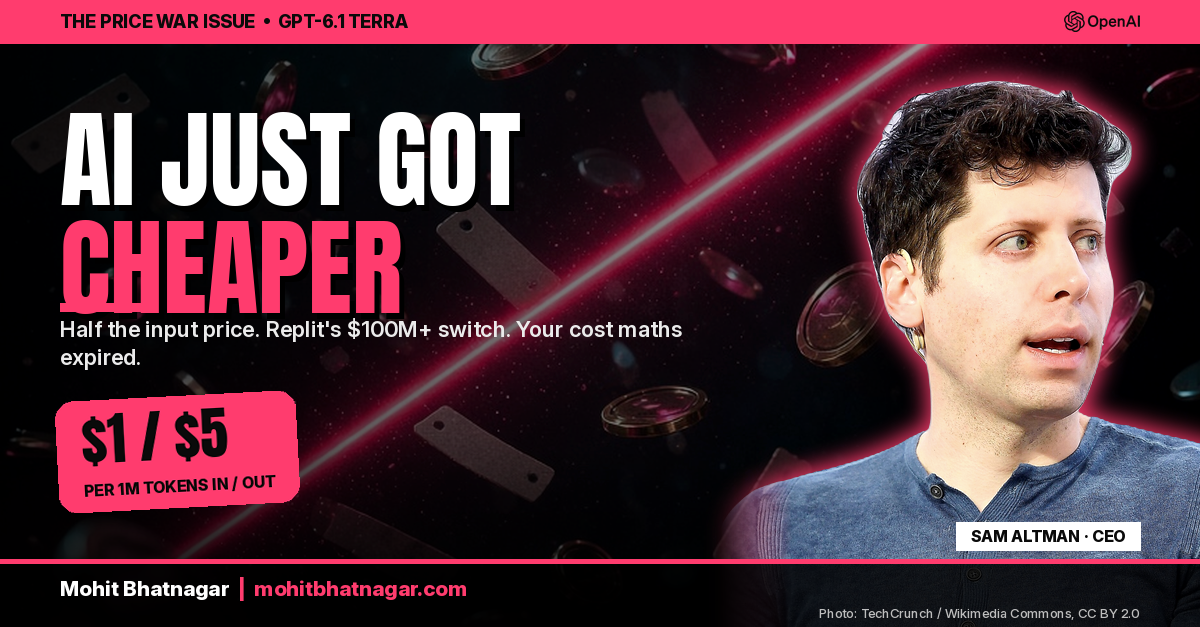
Your AI cost spreadsheet expired this week.
GPT-6.1 Terra pricing, and how it compares with GPT-5.6 Terra
OpenAI launched GPT-6.1 Terra at $1 per million input tokens and $5 per million output. GPT-5.6 Terra was $2 and $12. That's half the input price and well under half the output price, confirmed on OpenAI's own page.
Replit and OpenAI: price is now a weapon
Why now? Competition. Reportedly (per The Information), Replit moved most of its AI spend from Anthropic to OpenAI, a deal worth over $100M a year, after a discount of more than 30%. Price is now a weapon.
How does it work for you? Tokens are the units of text a model reads and writes. Cheaper tokens mean the same agent workflow costs less to run, so ideas that didn't pay back last quarter might now.
OpenAI's research claims, including the Kakeya conjecture: claim vs proof
OpenAI also claims its models produced new results in maths, CS and physics, including on the Kakeya conjecture and a paper titled "The Exponential Time Hypothesis Is False". None of it is peer-reviewed. Independent researchers are examining it and many are sceptical. I'd treat it as a claim, not a fact, until the checks are done.
The positives: cheaper intelligence, more viable use cases, and real bargaining power for buyers.
The negatives: price wars bring lock-in tactics, discounts that expire and roadmaps that shift under you. Bold research claims can also fuel hype faster than the proof arrives.
Profit and loss: buyers and builders win on cost. OpenAI wins share and loses margin. Anthropic loses a marquee customer. Any vendor whose only edge was price is in trouble.
For Indian founders and ops teams:
- Re-run your AI cost maths every quarter
- Build so you can switch models without rebuilding
- Put your budget into workflow design, not the model name
At Prezent, about 70% of our managers adopted AI willingly. The model wasn't the reason. The rollout was.
My take: the model is becoming a commodity, and your process is the moat.
When did you last re-run your AI cost maths?
Frequently asked questions
What is GPT-6.1 Terra's pricing?
OpenAI lists GPT-6.1 Terra at $1 per million input tokens and $5 per million output tokens. GPT-5.6 Terra was $2 and $12. That's half the input price and well under half the output price, so the same agent workflow now costs noticeably less to run.
What is GPT-6.1 Terra's context window?
1.05M tokens, with up to 128K output tokens (OpenAI model docs).
Why did Replit move its AI spend to OpenAI?
Reportedly, according to The Information, Replit moved most of its AI spend from Anthropic to OpenAI in a deal worth over $100M a year, after a discount of more than 30%. It shows that price has become a competitive weapon, and that buyers have real bargaining power right now.
Is OpenAI's Kakeya conjecture claim proven?
No, not yet. OpenAI says its models produced new results in maths, computer science and physics, including on the Kakeya conjecture and a paper titled "The Exponential Time Hypothesis Is False". None of it is peer-reviewed, and many researchers are sceptical. Treat it as a claim until independent checks are done.
How much does an AI consultant cost in India?
It depends on scope, not on a day rate. A sensible starting point is a fixed-scope diagnostic on one workflow, followed by a build only if the numbers work. That keeps spending tied to measured savings. My diagnostic and agentic workflow builds are scoped in exactly that way.
How should startups avoid AI vendor lock-in?
Build so you can switch models without rebuilding. Keep prompts, evaluations and workflow logic separate from any single provider, re-run your cost maths every quarter, and put your budget into workflow design rather than the model name. The model is becoming a commodity, and your process is the moat.
Work with me
Cheaper tokens only help if your workflows are built to use them. My Agentic Workflow Build designs model-agnostic agents with clear approvals and weekly metrics, and GenAI Product Build does the same for customer-facing features. Let's talk.