
Nvidia wants rent: the $2,000 per GPU agent software fee
Jensen Huang floated about $2,000 per GPU per year for agent software. Why Nvidia is moving from chips to subscriptions, and how to stay portable.
By Mohit Bhatnagar ·
At GTC Berlin, Jensen Huang said running Nvidia's agent software costs "about $2,000 per GPU per year" (Tom's Hardware). It was an example, not a published price. If it happens, agent software would be another recurring line on top of the hardware.
| Floated agent software fee | ~$2,000 per GPU per year (Tom's Hardware) |
|---|---|
| Status | Example, not an announced price |
| Market move | Nvidia ~+2.4% on the day of Anthropic's IPO filing |
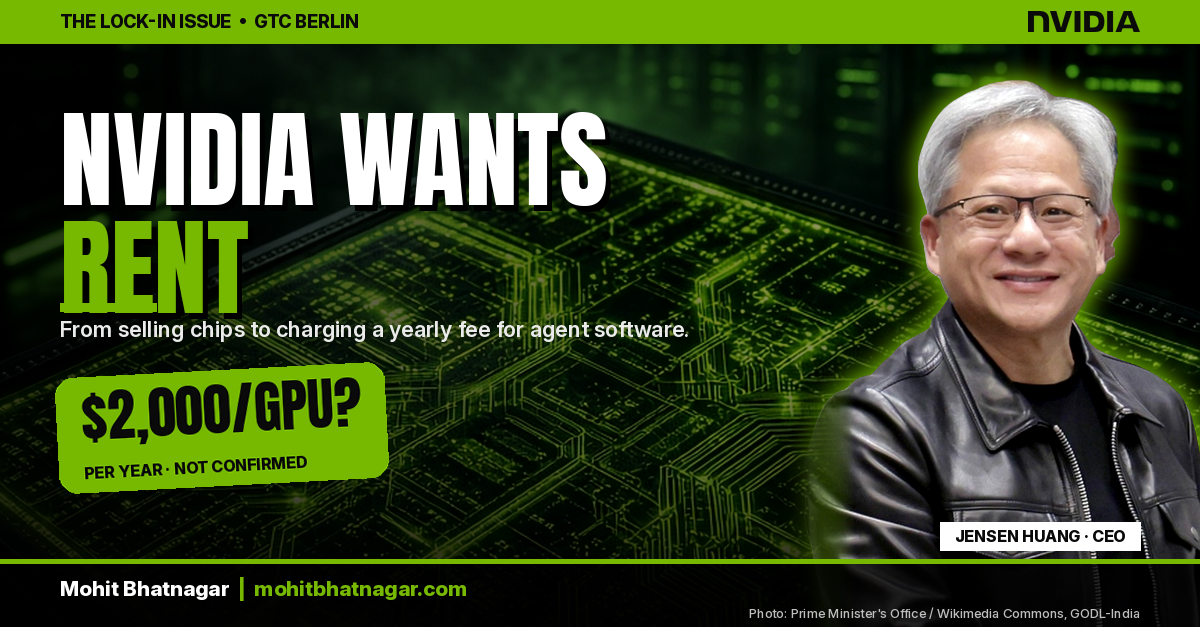
Nvidia doesn't just want to sell you chips. It wants rent.
What Jensen Huang said about a $2,000 per GPU software fee
At GTC Berlin, Jensen Huang said it's "about $2,000 per GPU per year" to run Nvidia's software for agents, per Tom's Hardware. To be clear, it was an example, not an announced price, and scope and timing are unclear. For context, Nvidia's AI Enterprise suite is already listed at $4,500 per GPU for a one-year subscription, including support (Nvidia's official pricing guide).
Nvidia AI Enterprise pricing and the shift from sale to subscription
Why? Hardware is a one-off sale, while software is recurring revenue. Every chip company dreams of turning a sale into a subscription.
How would it work? Think of the GPU as the factory and the software as the operating licence. You buy the factory once and renew the licence every year.
Meanwhile, the market loves Nvidia. It rose about 2.4% on Anthropic's IPO filing, and Korean memory makers rallied with it.
The positives: a more complete, supported stack and faster time to deploy for teams that don't want to build it themselves.
The negatives: costs that stack up quietly. Chips, runtime, agent software and licences each become a recurring line item. The deeper you go into one vendor's stack, the harder it is to leave.
Profit and loss: Nvidia wins twice, on the sale and on the subscription. Big buyers can absorb it. Smaller teams renting compute will feel it passed down in cloud prices.
How to keep your agentic AI stack portable
For Indian founders and ops teams:
- List every per-seat, per-GPU and per-token fee in your agent stack
- Ask vendors for cost per task, not just a price list
- Keep an exit path with open standards and portable workflows
I took quality at Prezentium from 76% to 99%+ by measuring what mattered every single week. AI spend deserves the same discipline before the licences pile up.
My take: Nvidia's moat is moving from silicon to software. Smart. But your job is to stay portable.
How locked in is your agent stack today?
Frequently asked questions
Is Nvidia charging $2,000 per GPU for agent software?
Not officially. At GTC Berlin, Jensen Huang said it's "about $2,000 per GPU per year" to run Nvidia's software for agents, according to Tom's Hardware. It was an example, not an announced price, and its scope and timing are unclear. Treat it as a direction of travel.
How much is Nvidia AI Enterprise per GPU?
Nvidia's AI Enterprise suite is already listed at $4,500 per GPU for a one-year subscription, including support (Nvidia's official pricing guide). That shows Nvidia already sells recurring software licences on top of hardware, and any agent-specific fee would add another line item to the stack.
Why does Nvidia want recurring software revenue?
Hardware is a one-off sale, but software renews every year. Think of the GPU as the factory and the software as the operating licence. Nvidia wins twice, while smaller teams renting compute may see the cost passed on in cloud prices.
What does a forward deployed engineer do in AI projects?
A forward deployed engineer works inside your team to turn AI into running workflows, connecting models, data and approvals to real processes. For startups, that kind of hands-on build often matters more than picking a vendor. My agentic workflow builds work in this embedded, forward-deployed way.
How do I avoid Nvidia software lock-in for AI agents?
List every per-seat, per-GPU and per-token fee in your agent stack, and ask vendors for cost per task, not just a price list. Keep an exit path with open standards and portable workflows. The deeper you go into one vendor's stack, the harder it is to leave, so stay portable.
Work with me
Before the licences pile up, list every per-seat, per-GPU and per-token fee in your stack. My Operations Diagnostic measures cost per task across your AI tools, and the Agentic Workflow Build keeps them portable. Get in touch.